
Current Temperature
 Log In
Boundary report proposes restructuring Lethbridge area into four constituencies
Posted on November 6, 2026 by Vauxhall Advance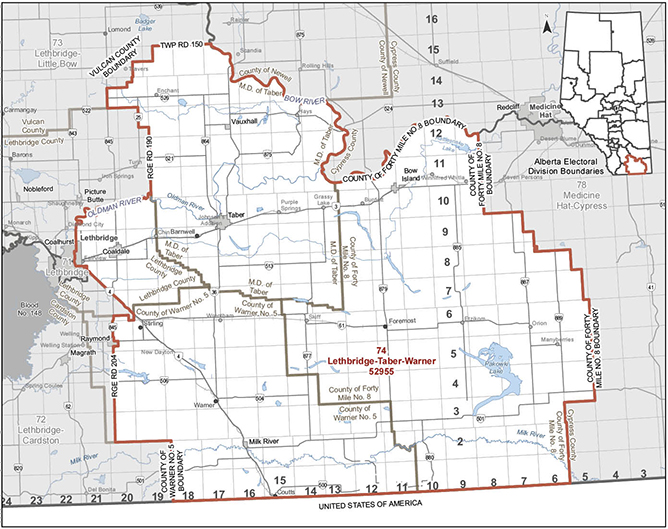 Advance Map Courtesy of Legislative Assembly of Alberta
BIG CHANGES: Lethbridge-Taber-Warner’s estimated population is 52,955.
• Vauxhall to become part of Lethbridge-Taber-Warner riding
A comprehensive report from the provincial Independent Advisory Panel on Electoral Boundaries released Nov. 2 in the Legislative Assembly recommends a sweeping reconfiguration of southern Alberta’s political map, expanding the Lethbridge area from two stand-alone urban ridings into four hybrid electoral divisions.
Under the panel’s majority-proposed redistribution, the City of Lethbridge would lend portions of its municipal population along its outer boundaries to three surrounding regional constituencies, while preserving a single central urban riding composed entirely of city residents.
The proposal fundamentally reshapes how Lethbridge and surrounding communities are represented in Edmonton, replacing the existing Lethbridge-East and Lethbridge-West riding structure with an interconnected regional system centred on southwestern Alberta’s agricultural and economic core.
According to the panel’s official report, the central Lethbridge riding would have an estimated population of 58,897 residents, comprising roughly 60 per cent of the city’s overall population. The constituency would unite downtown Lethbridge, mature central neighbourhoods and established residential developments on both sides of the Oldman River.
Beyond the urban core, the remaining Lethbridge population would be divided among three expanded hybrid ridings that pair city residents with neighbouring towns, villages and rural municipal districts across southern Alberta.
Under the majority plan, Lethbridge-Little Bow would be re-established as a constituency of 52,662 residents. The riding would combine portions of north and west Lethbridge along Highway 3 with the Town of Coalhurst, Picture Butte, Iron Springs, Nobleford, Barons, Carmangay, Champion, Vulcan and Lomond, extending north across the Bow River to the Siksika Nation boundary.
To the east, Lethbridge-Taber-Warner would incorporate 6,679 residents from eastern Lethbridge neighbourhoods, including the Exhibition Park fairgrounds, the Lethbridge Research and Development Centre and adjacent communities north of the primary rail line. The constituency of 52,955 people would stretch east along the Highway 3 Premier Food Corridor through Coaldale, Barnwell, Taber, Vauxhall and Bow Island, as well as south along Highway 4 to Warner, Milk River and the international border crossing at Coutts.
South of the city, Lethbridge-Cardston would draw approximately 17,000 residents from southern and western Lethbridge to join Raymond, Magrath, Cardston, Glenwood and Hill Spring. The riding, with a proposed population of 41,943, would also encompass the Kainai Blood Reserve, Canada’s largest First Nation reserve by land area.
The panel proposal also triggers significant changes for Macleod-Crowsnest to the west. Re-establishing the Lethbridge hybrid ridings allows Macleod-Crowsnest to run from Fort Macleod west to Crowsnest Pass and Pincher Creek, and north along Highway 2 through Claresholm, Stavely and Nanton to High River, eliminating the previous commission configuration that surrounded Lethbridge on three sides. The report says Lethbridge serves as the principal economic, educational, medical and judicial hub for southwestern Alberta, arguing that municipal boundaries should not act as impermeable walls when defining regional communities of interest.
Panelists highlighted the Canada Premier Food Corridor, regional irrigation networks, logistics chains and processing facilities as evidence of deeply integrated communities of interest linking Lethbridge directly to Lethbridge County, Coaldale, Taber and surrounding agricultural regions.
By borrowing population from Lethbridge’s municipal perimeter, the panel majority argues that southern Alberta can maintain five viable regional constituencies without forcing rural ridings to expand across unmanageable geographical distances to meet provincial population targets.
The panel says hybrid ridings are common across Alberta, with 17 of the province’s 19 incorporated cities participating in blended urban-rural electoral divisions to balance population distribution and maintain effective regional representation.
However, the recommendations revealed sharp divisions within the advisory panel. Two minority panel members issued a detailed dissent, arguing the Lethbridge proposals exceed the panel mandate and inappropriately dilute urban voting power.
The minority opinion contended that Government Motion 37 was intended strictly to restore two rural ridings deleted by the 2025-2026 Electoral Boundaries Commission rather than execute broad redistricting across southern Alberta. They warned that transferring urban voters into expansive rural ridings undermines the principle of effective representation and risks potential constitutional challenges under the Canadian Charter of Rights and Freedoms.
The majority report defended the process as a necessary iterative step in electoral boundary mapping, and final decision-making authority rests with the Legislative Assembly.
The report has been formally submitted to the Select Special Committee on Electoral Boundaries for further evaluation before any statutory amendments to the Electoral Divisions Act are brought forward for debate in the Legislature.
Leave a Reply
You must be logged in to post a comment.